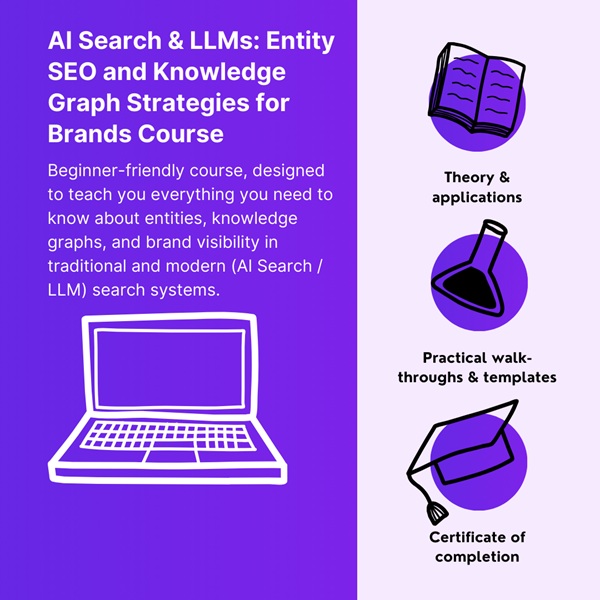
[GroupBuy] AI Search & LLMs: Entity SEO and Knowledge Graph Strategies for Brands 2026
$229.00 $65.00
- Delivery: You Will Receive A Receipt With Download Link Through Email.
- If you need more proof ofcourse, feel free to chat with me!

Description
In an increasingly sophisticated digital landscape, the confluence of AI Search & LLMs: Entity SEO and Knowledge Graph Strategies for Brands represents the new frontier for establishing and maintaining brand visibility and authority. As search environments evolve, moving past simple keyword matching towards an understanding of meaning and context, brands must adapt by translating their core values into structured, data-driven signals that resonate with intelligent agents and large language models, ensuring precise digital representation within the global knowledge ecosystem.
The Paradigm Shift – From Keywords to Entities in Modern Search

The digital firmament is undergoing a profound transformation, steering away from the legacy paradigm of keyword-centric search towards a more sophisticated, entity-based understanding. Modern search environments, profoundly influenced by Large Language Models (LLMs) and autonomous AI agents, no longer simply match text strings; they prioritize meaning, context, and the intricate relationships between distinct concepts.
This fundamental shift marks a new era where a brand’s online presence is not merely about the phrases it uses, but how it is comprehensively understood, recognized, and trusted as a unique, definable entity within a vast semantic network. Brands that embrace this change proactively are not just optimizing for today’s algorithms, but are laying the groundwork for enduring relevance in a future where AI mediates virtually every digital interaction, shaping perception and facilitating discovery in ways traditional SEO could never achieve. The strategic pursuit of entity SEO is therefore not aspirational but imperative, demanding a deep understanding of semantic consistency and the sophisticated architecture underpinning AI-driven search.
Defining Entities and Meaning in the AI Era
The foundational difference between entities and keywords lies at the heart of semantic search. Keywords are, by definition, lexical strings—words or phrases people type into a search bar. Their utility is diminishing as AI becomes more adept at discerning intent and meaning far beyond surface-level text. Entities, in contrast, are distinct, well-defined concepts that can be unambiguously identified by machines. These might be people, places, organizations, ideas, or products, each with unique attributes and relationships to other entities. Imagine “Apple” as a keyword might refer to a fruit or a tech company; as an entity, “Apple Inc.” is a specific corporation with identified products, a founder, and a market capitalization.
This precision is paramount for LLMs and search engines striving to process and present accurate information. The Entity-Attribute-Value (EAV) model is a powerful concept originating from database design that has found renewed importance in semantic analysis, providing a structured way to define these entities. In the EAV model, an Entity (e.g., “Apple Inc.”) possesses Attributes (e.g., “CEO,” “Founding Year,” “Headquarters”) each with specific Values (e.g., “Tim Cook,” “1976,” “Cupertino, California”). This structured, granular definition allows AI systems to build rich profiles and understand complex relationships, moving beyond mere linguistic interpretations to a profound semantic comprehension. The meticulous application of the EAV model ensures that brands can communicate their identity and offerings with unparalleled clarity, not just to human users but to the intelligent systems that increasingly mediate their discovery.
The pursuit of semantic consistency is another critical pillar in establishing brand visibility and trust with AI systems. In a digital world where information can be ambiguous or contradictory, machines, much like humans, seek reliable, unambiguous sources. For brands, this translates into presenting a unified, consistent narrative across all digital touchpoints. Every piece of content, every data point, and every mention of the brand must align to paint a coherent picture of “who they are” and “what they stand for.”
Inconsistency creates noise, introduces uncertainty, and ultimately diminishes a brand’s authority in the eyes of an AI agent, which is programmed to prioritize accuracy and trustworthiness. This isn’t just about SEO; it’s about digital reputation engineering. A brand’s semantic footprint—the sum total of its entity definitions, attributes, and relationships—must be meticulously managed to ensure that when an LLM is asked about it, the response is not just correct but also reflects the intended brand identity and values. This level of precision requires a proactive approach to content creation, data structuring, and cross-platform information management, transforming brand communication into a finely tuned, machine-readable language.
My personal analysis suggests that the true genius of this shift lies in its mirroring of human cognition. We, as humans, don’t perform “keyword searches” in our minds; we query our internal “knowledge graphs” of interconnected concepts. When someone asks about “sustainable fashion,” our brains don’t just look for those two words; they connect to designers known for ethical practices, materials with low environmental impact, certifications, and companies with transparent supply chains. LLMs are engineered to replicate this higher-order cognitive function. Therefore, brands adopting an entity-first approach aren’t just optimizing for an algorithm; they are optimizing for a more natural, intuitive form of information retrieval that aligns with how people conceptualize and relate to brands. This deeper understanding will forge stronger, more resilient brand perception, as AI systems become advocates for brands they truly “understand,” presenting them accurately and favorably in dialogical search experiences. The future competitive edge will belong to brands whose digital representation is so semantically robust that AI becomes their most articulate and trusted spokesperson.
The Role of LLMs in Search Pipeline Architecture
Large Language Models have fundamentally restructured the search pipeline, embedding an entirely new layer of semantic processing that was previously unimaginable. Traditional search algorithms relied heavily on index matching and link signals. While these still play a role, LLMs now act as sophisticated interpreters, taking raw search queries and documents, and leveraging their vast training data to understand the underlying entities, intents, and relationships.
They don’t just look for keywords; they dissect the query to identify the primary entity of interest, its attributes, and the user’s desired outcome. This semantic understanding guides the retrieval process, enabling agents to fetch highly relevant information even if the exact keywords aren’t present in the source text. This is why AI Search & LLMs: Entity SEO and Knowledge Graph Strategies for Brands is so critical; brands must structure their information to be easily parsable by these sophisticated models at every stage of their complex pipeline architectures, where NLP features are not just outputs but crucial training inputs that refine the models continuously.
Specifically, the NLP features that LLMs use are not just about grammar and syntax; they delve into named entity recognition, sentiment analysis, topic modeling, and coreference resolution. These features act as the sensory input for LLMs, allowing them to build internal representations of the world, including brands. For a brand, this means that every piece of text it publishes—from website copy to social media posts, press releases, and forum discussions—contributes to its entity profile within an LLM’s understanding.
If a brand inconsistently uses terminology, if its product names are ambiguous, or if its values are not clearly articulated, the NLP pipeline will struggle to create a coherent entity representation. Conversely, a brand that meticulously defines its entities, attributes, and values with clarity and consistency across all content will provide robust training inputs to LLMs, resulting in its accurate recognition and favorable representation. My personal observation suggests that this shifts the focus from merely writing for human consumption to writing with an acute awareness of machine interpretability, demanding a new level of informational hygiene and semantic rigor from content creators.
The ultimate manifestation of this LLM-driven search evolution is the rise of agent-driven discovery. Search is no longer a passive act of typing and clicking; it’s transforming into a personalized, proactive, and often dialogical experience mediated by intelligent agents. These agents, trained on and powered by LLMs, can anticipate user needs, synthesize information from multiple sources, and present curated, contextually relevant answers. They don’t just give you a list of links; they might answer a question directly, provide a summary, or even execute tasks on your behalf.
For brands, this means visibility is no longer just about ranking 1 in organic search results. It’s about being the trusted, accurately represented entity that these autonomous agents recommend, cite, or use to inform their responses. The authority is earned through accuracy, trust, and the precise digital representation of a brand within the global knowledge ecosystem. This implies that competitive intelligence in the era of LLMs extends beyond traditional keyword analysis to understanding how competitor entities are being recognized and presented by AI systems, allowing brands to engineer their own positions within these agent-mediated interactions.
Knowledge Graph Integration and Optimization for Brand Authority
At the architectural core of entity-based search and LLM comprehension lies the knowledge graph. This sophisticated semantic infrastructure allows search engines and AI systems to not only understand individual entities but crucially, to grasp the intricate relationships between them. For brands striving to achieve prominence in the AI era, actively engaging with and optimizing for knowledge graphs is no longer an optional add-on but a fundamental prerequisite for digital visibility and authority.
These graphs are the connective tissue of the semantic web, mapping out facts, concepts, and their interconnections in a machine-readable format. Brands must recognize that their ultimate representation in AI-driven search will largely be dictated by their presence and definition within these powerful semantic databases, making strategic investment in AI Search & LLMs: Entity SEO and Knowledge Graph Strategies for Brands an essential component of modern digital marketing.
Google’s Knowledge Graph Architecture and Brand Presence
Google’s Knowledge Graph stands as a colossal example of semantic infrastructure, continually evolving to enrich its understanding of the world. Its architecture is built upon complex systems dedicated to fact acquisition, meticulously gathering entities and their attributes from a vast array of web sources. This process is not random; it’s informed by sophisticated algorithms, advanced machine learning, and insights gained from extensive patent analysis, which often reveal the directional thinking behind Google’s technical advancements.
The system processes billions of data points daily, identifying named entities, extracting facts, and establishing relationships, prioritizing signals that indicate authority, accuracy, and consistent information. For brands, being present and accurately defined within Google’s Knowledge Graph is akin to having a verified, authoritative entry in the world’s largest digital encyclopedia. An accurate knowledge panel, rich with relevant facts and images, signifies that Google definitively “knows” who you are, what you do, and how you relate to other entities, boosting trust and visibility in search results and AI-generated responses.
Understanding how a brand is currently represented within Google’s database is a critical first step for any entity optimization strategy. Tools like the Google Knowledge Graph API allow for direct, manual interrogation, providing a window into how specific entities are formally understood by Google. This is invaluable for identifying discrepancies, missing information, or outdated facts that could hinder a brand’s visibility or misrepresent its identity. Beyond manual checks, large-scale analysis using the API can reveal broader trends in entity recognition, highlighting strengths and weaknesses in a brand’s semantic footprint compared to competitors.
This data retrieval and analysis is not a one-time task but an ongoing process, as the Knowledge Graph is dynamic, constantly updating with new information and refining existing relationships. My expertise indicates that brands often overlook the importance of proactively monitoring their knowledge panel and associated data, leaving their digital identity to chance. However, proactive engagement allows brands to assert control over their narrative within Google’s powerful semantic index, ensuring that the critical data points—such as leadership, products, services, and locations—are consistently accurate and optimized for machine consumption.
The implications of Google’s Knowledge Graph for brand authority extend far beyond merely appearing in search results. When Google’s systems confidently understand a brand entity, it can surface information in various rich formats: direct answers, featured snippets, knowledge panels, and perhaps most importantly in the context of LLMs, as foundational facts for general AI conversations. If an LLM is asked about a brand, its first port of call for factual information is often a structured source like Google’s Knowledge Graph. A brand whose information is thoroughly and accurately represented here is significantly more likely to be cited, mentioned, and recommended by AI systems when relevant. Conversely, a brand with a weak or inconsistent Knowledge Graph profile may find itself overlooked or misrepresented, severely limiting its discoverability in an agent-mediated future. This makes the strategic integration with and optimization for Google’s Knowledge Graph a cornerstone of any forward-thinking AI Search & LLMs: Entity SEO and Knowledge Graph Strategies for Brands.
Building Proprietary Semantic Infrastructure
While leveraging public knowledge graphs like Google’s is crucial, forward-thinking organizations are increasingly moving towards building and maintaining their own proprietary semantic infrastructure—their private knowledge graphs. These internal graphs serve as the ultimate source of truth for all brand-related data, allowing companies to meticulously define their products, services, personnel, locations, and brand values with a granularity and precision unmatched by external sources.
A proprietary knowledge graph becomes the central hub from which all entity information originates and is disseminated, ensuring perfect consistency across all platforms and content. This level of control is paramount in an environment where AI systems demand unambiguous, consistent data. By owning their semantic infrastructure, brands can create a robust, authoritative digital representation that is always current, accurate, and aligned with their strategic objectives, making their content inherently more accessible and understandable to intelligent agents.
The development of such a knowledge graph is a substantial undertaking, requiring careful planning, robust data modeling, and ongoing maintenance. Organizations must identify their core entities, define their attributes, and map out the relationships between them. This is not merely a technical exercise; it’s a strategic one, forcing brands to clarify their identity and internal structure in a machine-readable way. Tools and platforms exist that facilitate this development, enabling the creation of custom ontologies and the integration of diverse data sources. Once built, this proprietary semantic infrastructure acts as a powerful internal asset, guiding content creation, informing website architecture, and serving as a direct feed for structured data implementation. For example, if a product feature changes, updating it in the proprietary knowledge graph automatically propagates that change across the entire digital ecosystem, ensuring all internal systems and external expressions of the brand remain semantically consistent and up-to-date for LLMs.
Crucially, the full power of a proprietary knowledge graph is realized through advanced schema markup. Schema.org vocabulary provides a standardized way to annotate content on web pages with structured data, making it explicitly machine-readable. However, beyond basic article or product schema, the real advantage lies in defining multi-entity relationships and linking them back to the brand’s proprietary graph. This might involve marking up not just a product, but its manufacturer, its ingredients (if applicable), its use cases, its reviews, and its relationships to other related products or services, all interconnected by unique identifiers defined in the internal knowledge graph.
This rich web of interconnected data reinforces entity recognition for search engines and LLMs, solidifying the brand’s authoritative presence. The ultimate goal is to transition a website into a fully semantic-friendly platform, where every piece of content, every page, and every interaction is underpinned by structured data that aligns seamlessly with broader knowledge graph standards and the brand’s own semantic blueprint. This creates a data-rich environment where AI can easily navigate, understand, and extract information about the brand, cementing its position in the emerging landscape of AI Search & LLMs: Entity SEO and Knowledge Graph Strategies for Brands.
Strategic Brand Authority Engineering for LLM Success
In the dialogical, agent-mediated digital landscape, brand authority is no longer solely built on traditional advertising or even organic search rankings. Instead, it is increasingly engineered through precise digital representation, semantic consistency, and the strategic positioning of a brand within the global knowledge ecosystem that LLMs and intelligent agents consult. Brands must adopt a systematic approach to reputation management and competitive positioning, ensuring they are not just “found” but are actively understood, trusted, and recommended by AI systems. This requires a shift from reactive brand management to proactive brand authority engineering, where every digital signal contributes to a meticulously crafted entity profile designed for optimal machine comprehension and trust.
The BRIDGE Framework for Entity Optimization
The challenge for many brands embarking on their entity SEO journey is often knowing where to start. The BRIDGE framework provides a structured, systematic approach to navigate this complex landscape, ensuring a comprehensive and actionable strategy for entity optimization.
- Bridge: The framework begins by identifying and bridging the critical gap between raw, unstructured brand data and strategic, execution-ready brand information. This first step involves a deep dive into all available brand assets, content, and external mentions to gather a holistic view of the current digital footprint. The goal is to transform disparate data points into a coherent, machine-readable dataset.
- Recognition: Following this, the focus shifts to discovering entity recognition gaps. This phase involves auditing how well LLMs and search engines currently understand and recognize the brand’s core entities, products, services, and key personnel. Are they consistently identified? Are there ambiguities? This diagnosis is crucial for pinpointing where the brand’s digital signals are currently failing to communicate effectively with AI systems, hindering discovery and accurate representation. Without precise recognition, even the most valuable brand information remains largely invisible to intelligent agents, making it imperative for **AI Search & LLMs: Entity SEO and Knowledge Graph Strategies for Brands.
- Improvement: Once gaps are identified, the next step is to develop a structured roadmap for entity improvement. This involves prioritizing which entities and relationships require the most urgent attention, outlining specific actions such as enhancing schema markup, refining content, or building out proprietary knowledge graph entries. The roadmap considers the brand’s strategic goals, competitive landscape, and the potential impact of each improvement on overall AI visibility and authority. This phase is about translating diagnostic insights into a clear, actionable plan that allocates resources effectively for maximum impact.
- Definition: The ‘D’ in BRIDGE relates to defining (or re-defining) the brand’s entities with explicit clarity. This moves beyond simply identifying gaps to actively constructing a robust, unambiguous semantic definition of the brand within its own knowledge graph. It involves clarifying attributes, establishing canonical names, and ensuring that every concept linked to the brand has a unique, consistent digital identifier. This stage is about building the brand’s foundational semantic layer, making it inherently understandable for machine processing.
- Governance: The final ‘G’ stands for Governance, emphasizing the ongoing management and maintenance of the brand’s entity profile. Entity SEO is not a one-off project but a continuous process. This involves establishing protocols for new content creation, data updates, and monitoring the entities’ performance within LLM responses. A robust governance strategy ensures that semantic consistency is maintained over time, adapting to new AI advancements and preventing the erosion of established brand authority.
This comprehensive framework enables brands to not only identify and fix current deficiencies but also to build a resilient, future-proof strategy for thriving in an AI-dominated search ecosystem.
Competitive Positioning in LLM Responses
The battle for brand visibility is increasingly shifting from the SERP (Search Engine Results Page) to the synthesized responses provided by LLMs. In this new arena, competitive positioning takes on a nuanced, strategic dimension focused on how a brand is represented, contrasted, and recommended by intelligent agents. Reputation engineering becomes paramount, as brands must actively control their narrative within AI responses, managing not just what is said, but how it is perceived.
This proactive approach involves ensuring that positive associations are amplified, negative sentiments are mitigated, and the brand’s core values are consistently reflected in AI-generated summaries and answers. My analysis highlights that this is more than just PR; it’s about meticulously crafting the digital signals that inform an LLM’s understanding of a brand’s societal standing, trustworthiness, and ethical framework. This involves leveraging public data, engaging with review platforms, and ensuring that all officially sanctioned content embodies the desired brand sentiment.
Furthermore, brands must actively engineer their positions relative to competitors within LLM-generated answers. This goes beyond traditional competitive keyword analysis. It involves understanding how competitor entities are defined, what attributes are highlighted for them, and in what contexts they are being cited by AI systems. By analyzing these data points, brands can identify opportunities to differentiate themselves semantically, strengthening their unique value proposition in the eyes of an LLM. For instance, if a competitor is widely recognized for “affordability,” a brand might strategically emphasize “durability” or “innovation” through its entity definitions and content. This requires an astute understanding of both its own and its rivals’ semantic profiles to curate a distinctive niche within the AI landscape, ensuring that when an LLM is asked to compare or contrast, the brand’s strengths are highlighted accurately and persuasively alongside those of its competitors.
Finally, the concept of co-citation emerges as a powerful strategy for enhancing brand authority. Co-citation involves strategically managing how a brand is mentioned alongside other reputable, authoritative entities. If a brand consistently appears in discussions or content alongside established industry leaders, respected academic institutions, or universally trusted organizations, it implicitly borrows from their authority. For LLMs, these patterns of co-occurrence act as strong signals of legitimacy and relevance. This isn’t about spamming; it’s about genuine collaboration, strategic partnerships, and thought leadership that naturally places the brand in proximity to highly regarded entities.
For example, a tech company might sponsor a renowned research conference, or a non-profit might partner with a respected university on a study, ensuring their names are legitimately linked in the digital knowledge graph. This strategic weaving of a brand into a network of trusted entities provides powerful contextual signals to LLMs, significantly bolstering its perceived authority and trustworthiness, a key aspect of successful AI Search & LLMs: Entity SEO and Knowledge Graph Strategies for Brands.
Technical Implementation and Operational Workflows for Entity SEO
The transition to entity-based SEO, while deeply strategic, is ultimately facilitated by robust technical implementation and finely tuned operational workflows. It requires a suite of specialized tools, rigorous auditing processes, and a commitment to pervasive data distribution. For brands, this isn’t merely about SEO anymore; it’s about building a sustainable, machine-understandable digital identity that can thrive in the era of Artificial Intelligence. The effective application of Named Entity Recognition, the systematic auditing of entity structures, and the diligent monitoring of LLM citations are not just technical tasks but critical components of ensuring a brand’s lasting relevance.
Named Entity Recognition (NER) and Extraction
Effective entity management begins with the ability to accurately identify and extract entities from vast amounts of existing content. Named Entity Recognition (NER), a core sub-task of natural language processing (NLP), is the cornerstone of this process. NER tools automatically scan text and classify words or phrases into predefined categories such as names of persons, organizations, locations, dates, monetary values, and, critically, specific brand-related entities like products or services. This automated extraction allows brands to efficiently audit their current content, identify discrepancies in entity mention, and ensure consistent identification across their digital footprint. Without robust NER capabilities, manually sifting through thousands of pages of content to identify and verify entities would be an insurmountable task.
Key tools for entity extraction are typically offered through advanced NLP APIs from major tech providers. The Google NLP API, for instance, provides sophisticated entity recognition capabilities, allowing analysis of text for known entities (like “Google,” “New York City”), their types, and the salience (importance) of each entity within the text. Similarly, Amazon Comprehend offers powerful text analytics that can identify entities, key phrases, and even gauge sentiment across various content types. IBM Watson NLU (Natural Language Understanding) also provides a comprehensive suite of text analysis features, including entity extraction, concept extraction, and semantic role labeling, which can reveal deeper relationships within the text. These APIs leverage vast pre-trained models, making them highly effective out-of-the-box solutions for brands looking to implement or audit their entity strategy.
A comparative analysis of Generative AI (like ChatGPT) versus specialized NLP APIs for entity extraction reveals different strengths. While generative AI models are remarkably capable of understanding context and generating human-like text, their primary design is not for precise, structured entity extraction for database population. They might infer entities or generate new ones, which can introduce inconsistencies for strict semantic database requirements. Specialized NLP APIs, however, are meticulously engineered for the task of identifying and classifying predefined entities with high accuracy and consistency, making them more reliable for building and maintaining structured entity data for AI Search & LLMs: Entity SEO and Knowledge Graph Strategies for Brands. Generative AI can assist in content creation with entity awareness, ensuring new content is entity-rich and semantically consistent, but for the actual extraction and auditing of structured entities from existing content, dedicated NLP APIs remain the superior and more dependable choice due to their focused accuracy and adherence to predefined ontological structures.
Auditing and Monitoring Entity Performance
Beyond initial extraction, the ongoing success of an entity SEO strategy hinges on continuous auditing and monitoring processes. Systematic reviews of a site’s entity structure are essential to identify where recognition is failing or where opportunities for improvement exist. These entity audits involve cross-referencing identified entities from content with their representation in proprietary knowledge graphs and external knowledge bases like Google’s Knowledge Graph.
A recognition gap occurs when an entity present in the brand’s content (e.g., a specific product feature) is not being correctly identified, indexed, or associated by AI systems. Such gaps can severely hinder a brand’s ability to be understood by AI training sets, leading to missed opportunities for visibility in AI-generated answers or agent-mediated discoveries. These audits provide actionable insights, guiding refinements to content, schema markup, and knowledge graph entries to ensure optimal machine interpretability.
A critical aspect of monitoring is tracking LLM citations. As AI systems become primary information providers, it’s vital to understand when, where, and how a brand is being mentioned and cited by these intelligent agents. Deploying autonomous agents specifically to monitor, acquire, and optimize citations across the digital ecosystem allows brands to gain real-time insights into their AI-driven visibility. This involves tracking direct answers, summaries, and recommendations generated by LLMs that mention the brand, its products, or related entities. Analyzing the context of these citations can reveal whether the brand is being positively or negatively associated, what attributes are highlighted, and how compelling its presence is compared to competitors. This proactive monitoring enables swift intervention to correct misinformation, reinforce positive associations, and capitalize on emerging opportunities for brand amplification in AI-generated content.
The goal of this auditing and monitoring process is to bridge any identified recognition gaps, which represent areas where a brand’s identity is not fully comprehensible to AI systems. These gaps might stem from unclear entity definitions, inconsistent attribute values, or a lack of robust structured data. By systematically identifying these deficiencies, brands can develop targeted strategies to enhance their semantic footprint. This ensures that when LLMs process information about the brand, they encounter a complete, unambiguous, and consistently structured data set. This dedication to semantic precision is what distinguishes successful AI Search & LLMs: Entity SEO and Knowledge Graph Strategies for Brands from those relying on outdated methods, as it directly impacts how accurately and authoritatively a brand is represented in a world increasingly powered by conversational AI and sophisticated search agents.
Cross-Platform Distribution and Operational Workflow
To truly reinforce entity recognition and build pervasive brand authority for LLMs, brand data must be strategically distributed across a multitude of platforms that serve as key training data sources for these models. While a brand’s website and official channels are fundamental, the diverse ecosystem of the internet provides ample opportunities to embed entity information in various, often overlooked, locations. Platforms like forums (e.g., Reddit) are rich repositories of natural language content, where user-generated discussions often reference brands, products, and industry topics.
By participating authentically and ensuring accurate entity mentions in these spaces, brands can contribute to the informal knowledge base that LLMs tap into for contextual understanding. Similarly, podcasts, through their transcripts and metadata, offer another valuable channel for embedding structured entity data and establishing authoritative signals. The presence of consistent, accurate entity information across these alternative digital channels creates a robust, multi-faceted digital footprint that significantly strengthens an LLM’s ability to recognize and understand a brand.
Sales Page:_https://academy.mlforseo.com/course/ai-search-llms-entity-seo-and-knowledge-graph-strategies-for-brands/
Delivery time: 12 -24hrs after paid